Warsaw, Jewish Historical Institute, Ms. 155
About the Ilan
TextGrid URI of the Editiontextgrid:4m1kg
FamiliesClassical ilan (Classical) 🔎︎Search for Ilanot in this Family
Surfaces of the Ilan
ב78
About the Manuscript
Identifiers and Titles
IdentifierWarsaw (Poland), Library of the Emanuel Ringelblum Jewish Historical Institute: Ms. 155
Primary Manuscript TitlesClassical Ilan
Alternative Manuscript TitlesWarsaw, Jewish Historical Institute, Ms. 155
NLI ID990001174620205171
Manuscript History
Origin
Date Information14th-15th century
Physical Description
MaterialPaper 🛈Refers generally to all types of thin matted or felted sheets or webs of fiber formed and dried on a fine screen from a pulpy water suspension. The fibers may be animal, such as hair, silk or wool, or mineral, such as asbestos, or synthetic. However most paper is made from cellulosic plant fiber, such as from wood pulp, grass, cotton, linen, and straw. 🔎︎Search for Ilanot with this Material
FormCodex 🛈Ancient manuscripts generally taking the form of the modern book: bound leaves of paper or parchment with information inscribed on both faces, attached at a center fold. For books that are printed rather than inscribed, before 1501, use 'incunabula.' 🔎︎Search for Ilanot with this Form
Hand DescriptionItalian
Content Description
SummaryThe Small Parchment preserved in Warsaw, Emanuel Ringelblum Jewish Historical Institute MS 155 (now lost) is a fifteenth-century Italian witness to a classical kabbalistic ilan type that circulated widely in manuscript culture. Early examples of this type were typically executed on a single parchment sheet. The Warsaw witness reflects the integration of such a sheet into a codex.
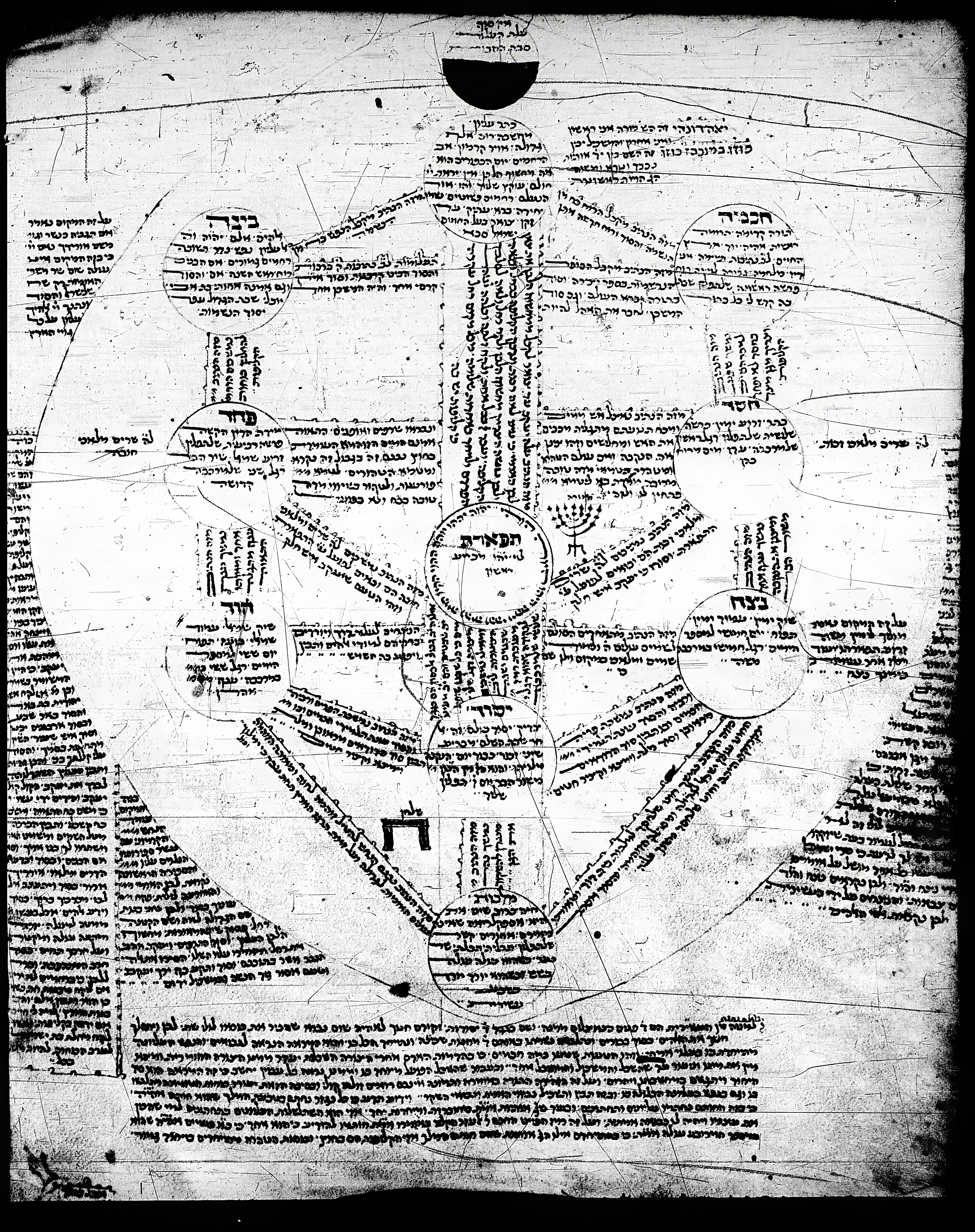
The ilan follows a copy of Maʿarekhet ha-Elohut (Order of the Divine) accompanied by the Perush Zulati (Commentary by Another), indicating that the diagram was intended to be consulted in conjunction with systematic theological study. The composition presents the ten sefirot in an arboreal configuration. Each medallion contains lists of sefirotic names and associations. The connecting channels (netivim) are inscribed with short textual units relating to directional flow within the structure. Flanking the tree are representations of the Menorah and the Table of the Showbread, positioned according to their Temple orientations. These elements embed the sefirotic structure within a symbolic sacred geography and underscore the diagram’s ordered, hieratic character.
The ilan follows a copy of Maʿarekhet ha-Elohut (Order of the Divine) accompanied by the Perush Zulati (Commentary by Another), indicating that the diagram was intended to be consulted in conjunction with systematic theological study. The composition presents the ten sefirot in an arboreal configuration. Each medallion contains lists of sefirotic names and associations. The connecting channels (netivim) are inscribed with short textual units relating to directional flow within the structure. Flanking the tree are representations of the Menorah and the Table of the Showbread, positioned according to their Temple orientations. These elements embed the sefirotic structure within a symbolic sacred geography and underscore the diagram’s ordered, hieratic character.
Further Information
Research LiteratureJ. H. Chajes, The Kabbalistic Tree (University Park, PA: Penn State University Press, 2022), 371–372.
Arthur Zacharias Schwarz, Die hebraeischen Handschriften in Oesterreich (Leipzig: Verlag von Karl W. Hiersemann, 1931), no. 242.
Arthur Zacharias Schwarz, Die hebraeischen Handschriften in Oesterreich (Leipzig: Verlag von Karl W. Hiersemann, 1931), no. 242.
Find more IlanotSearch for Ilanot on this Manuscript