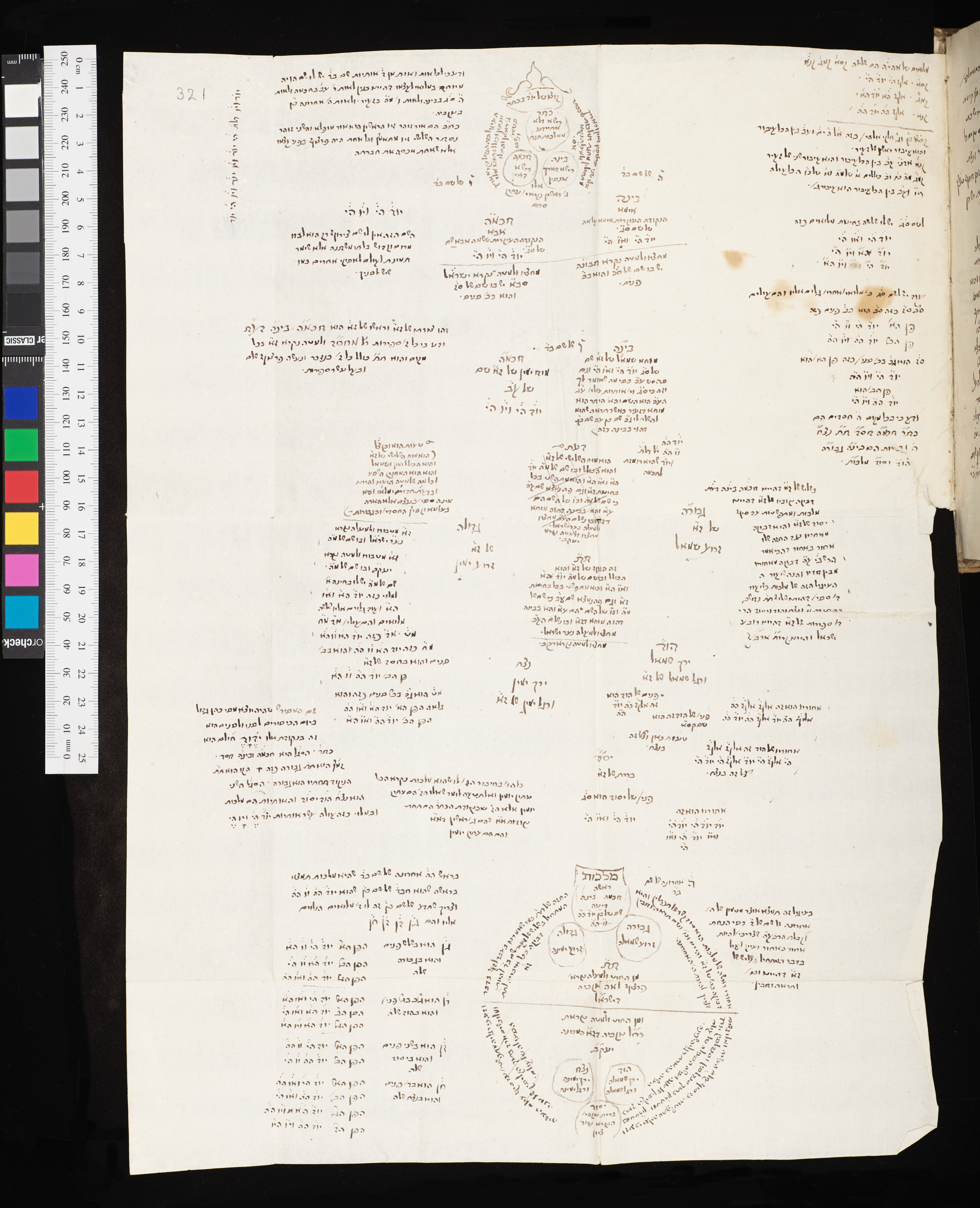
Oxford, BL, Ms. Opp. 458 321r
About the Ilan
TextGrid URI of the Editiontextgrid:4c2gw
FamiliesIlan of Expanded Names (Lurianic) 🔎︎Search for Ilanot in this Family
Surfaces of the Ilan
Recto
About the Manuscript
Identifiers and Titles
IdentifierOxford (United Kingdom), University of Oxford, The Bodleian Libraries: Ms. Opp. 458
Alternative Identifiers Oxford (United Kingdom), University of Oxford, The Bodleian Libraries: Ms. Opp. 973
Primary Manuscript TitlesThe Ilan of Expanded Names and Classical Ilan
Alternative Manuscript TitlesOxford, BL, Ms. Opp. 458
NLI ID990000591000205171
Manuscript History
Origin
Date Information17th century
Physical Description
FormFoldout 🛈Oversized pages in a book, magazine, or atlas which must be unfolded to be viewed. 🔎︎Search for Ilanot with this Form
Hand DescriptionAshkenazic
Content Description
SummaryThis seventeenth-century Ashkenazi kabbalistic miscellany is a document of exceptional historical significance, as it served as the primary source for Christian Knorr von Rosenroth’s integration of classical and Lurianic content in his Kabbala Denudata. The codex is unique for preserving two distinct paper foldouts bound in immediate succession. The first foldout contains the “Ilan of Expanded Names” (N), a single-origin Lurianic module that includes a specific textual “fingerprint” regarding the Tetragrammaton uttered by the High Priest on the Day of Atonement; Knorr translated this text directly from this source. The second foldout is a fine example of a high-quality classical ilan, aggregating the names and appellations of the sefirot within its medallions. It was from this classical diagram that Knorr obtained the sefirotic nomenclature he keyed to his Latin translations. Bound at the end of the miscellany is an anonymous classical commentary on the sefirot, which the scribe explicitly noted belongs to "the ilan commentary on ten sefirot." These two foldouts represent the idiosyncratic yet faithful synthesis of traditions that Knorr introduced to the non-Jewish scholarly world.
Further Information
Research LiteratureAdolf Neubauer, Catalogue of the Hebrew Manuscripts in the Bodleian Library and in the College Libraries of Oxford (Oxford: Clarendon Press, 1886).
J. H. Chajes, The Kabbalistic Tree (University Park, PA: Penn State University Press, 2022), 156–158, 385–386.
J. H. Chajes, The Kabbalistic Tree (University Park, PA: Penn State University Press, 2022), 156–158, 385–386.
Find more IlanotSearch for Ilanot on this Manuscript