Tel Aviv, GFC, Ms. GR.011.012
About the Ilan
TextGrid URI of the Editiontextgrid:4b4ss
FamiliesIlan of Expanded Names (Lurianic) 🔎︎Search for Ilanot in this Family
Surfaces of the Ilan
Recto
About the Manuscript
Identifiers and Titles
IdentifierTel Aviv, GFC, Ms. GR.011.012
Alternative IdentifiersIsrael, Wallach, Isaac: Ms. 376
Israel, Wallach, Isaac: Ms. 575
Primary Manuscript TitlesThe Ilan of Expanded Names
Alternative Manuscript TitlesTel Aviv, GFC, Ms. GR.011.012
NLI ID990034249070205171
Manuscript History
Origin
ContributorsAbulafia, Yedidya (Source)
R. Israel ben Asher Buchbinder (Scribe)
Romano, Shabbatai (Source)
Date1700 - 1800
Date Information18th century
Provenance
Provenance InformationHalfin, Moshe
Provenance InformationFormerly Wallach 376
Provenance InformationOn the inner side of the blank title page, owner signatures: "הצעיר דוד אברהם הלוי ס"ט".
OwnerGross, William L. (current owner)
Provenance PlacesTel Aviv (Israel)
Physical Description
MaterialPaper 🛈Refers generally to all types of thin matted or felted sheets or webs of fiber formed and dried on a fine screen from a pulpy water suspension. The fibers may be animal, such as hair, silk or wool, or mineral, such as asbestos, or synthetic. However most paper is made from cellulosic plant fiber, such as from wood pulp, grass, cotton, linen, and straw. 🔎︎Search for Ilanot with this Material
FormFoldout 🛈Oversized pages in a book, magazine, or atlas which must be unfolded to be viewed. 🔎︎Search for Ilanot with this Form
Support DescriptionIn calligraphic script. The title page and several other pages are decorated.
Number of Pages221
Dimensions Description370 × 240
Hand DescriptionSephardic
Languages Used
Main LanguageRabbinic Hebrew 🛈https://ilanot.org/voc/languages/he-x-rabbinic 🔎︎Search for Ilanot with this Language
Additional LanguagesRabbinic Hebrew 🛈https://ilanot.org/voc/languages/he-x-rabbinic 🔎︎Search for Ilanot with this Language
Content Description
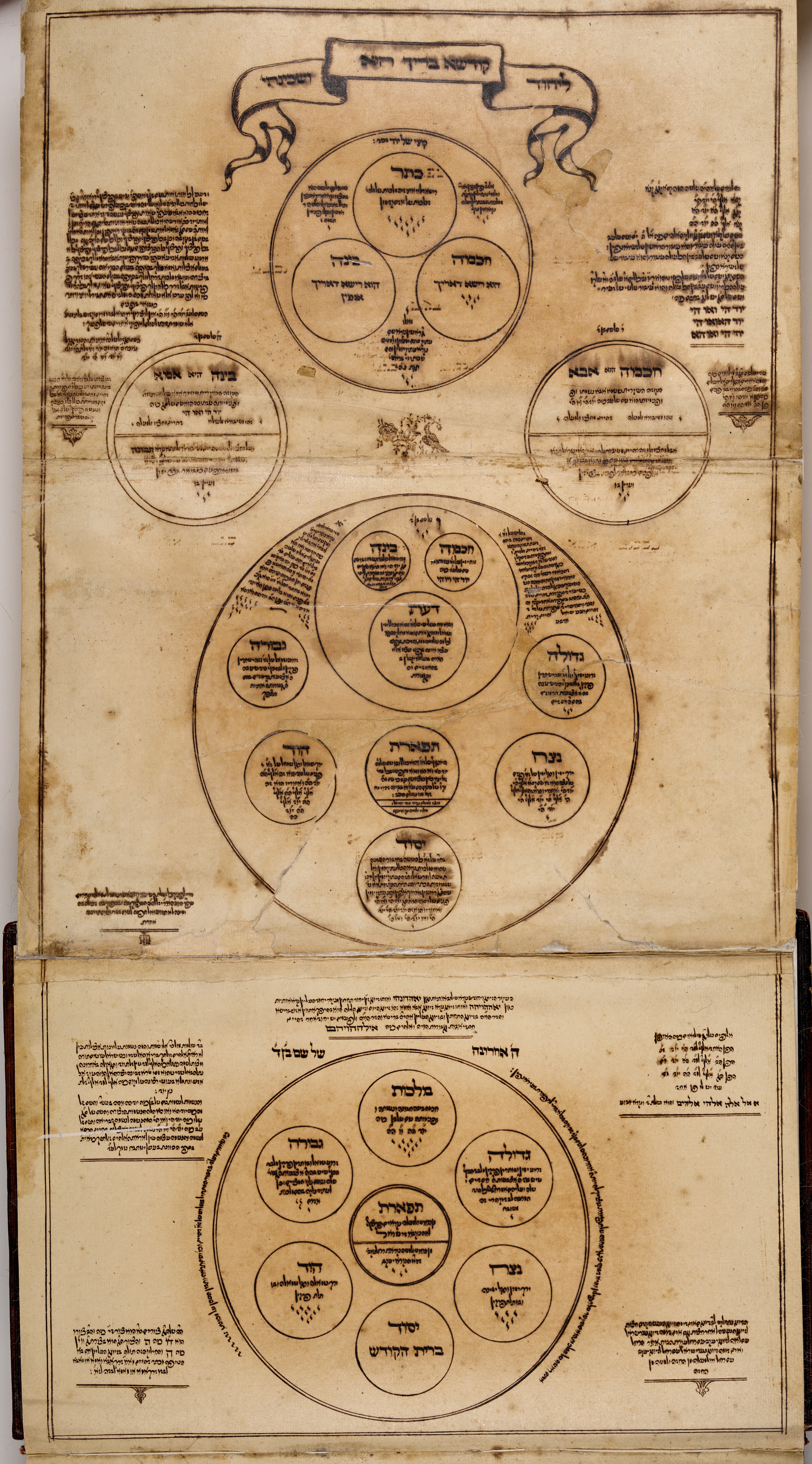
SummaryCopy of ‘Eẓ Ḥayyim by Ḥayyim ben Joseph Vital produced in 1729, richly decorated and including a fold-out “Ilan of Expanded Names” (N) sewn at the back.
Colophonישראל בן אשר בוכבינדר
Further Information
Research LiteratureJ. H. Chajes, The Kabbalistic Tree (University Park, PA: Penn State University Press, 2022), 158–161.
Find more IlanotSearch for Ilanot on this Manuscript