Prague, Jewish Museum, Ms. 69
About the Ilan
TextGrid URI of the Editiontextgrid:4b0zw
FamiliesIlan of Expanded Names (Lurianic) 🔎︎Search for Ilanot in this Family
Surfaces of the Ilan
Recto
About the Manuscript
Identifiers and Titles
IdentifierPrague (Czechia), Jewish Museum: Ms. 69
Primary Manuscript TitlesThe Ilan of Expanded Names
Alternative Manuscript TitlesPrague, Jewish Museum, Ms. 69
NLI ID990000637360205171
Manuscript History
Origin
Physical Description
MaterialPaper 🛈Refers generally to all types of thin matted or felted sheets or webs of fiber formed and dried on a fine screen from a pulpy water suspension. The fibers may be animal, such as hair, silk or wool, or mineral, such as asbestos, or synthetic. However most paper is made from cellulosic plant fiber, such as from wood pulp, grass, cotton, linen, and straw. 🔎︎Search for Ilanot with this Material
FormFoldout 🛈Oversized pages in a book, magazine, or atlas which must be unfolded to be viewed. 🔎︎Search for Ilanot with this Form
Dimensions Description70 × 32
Content Description
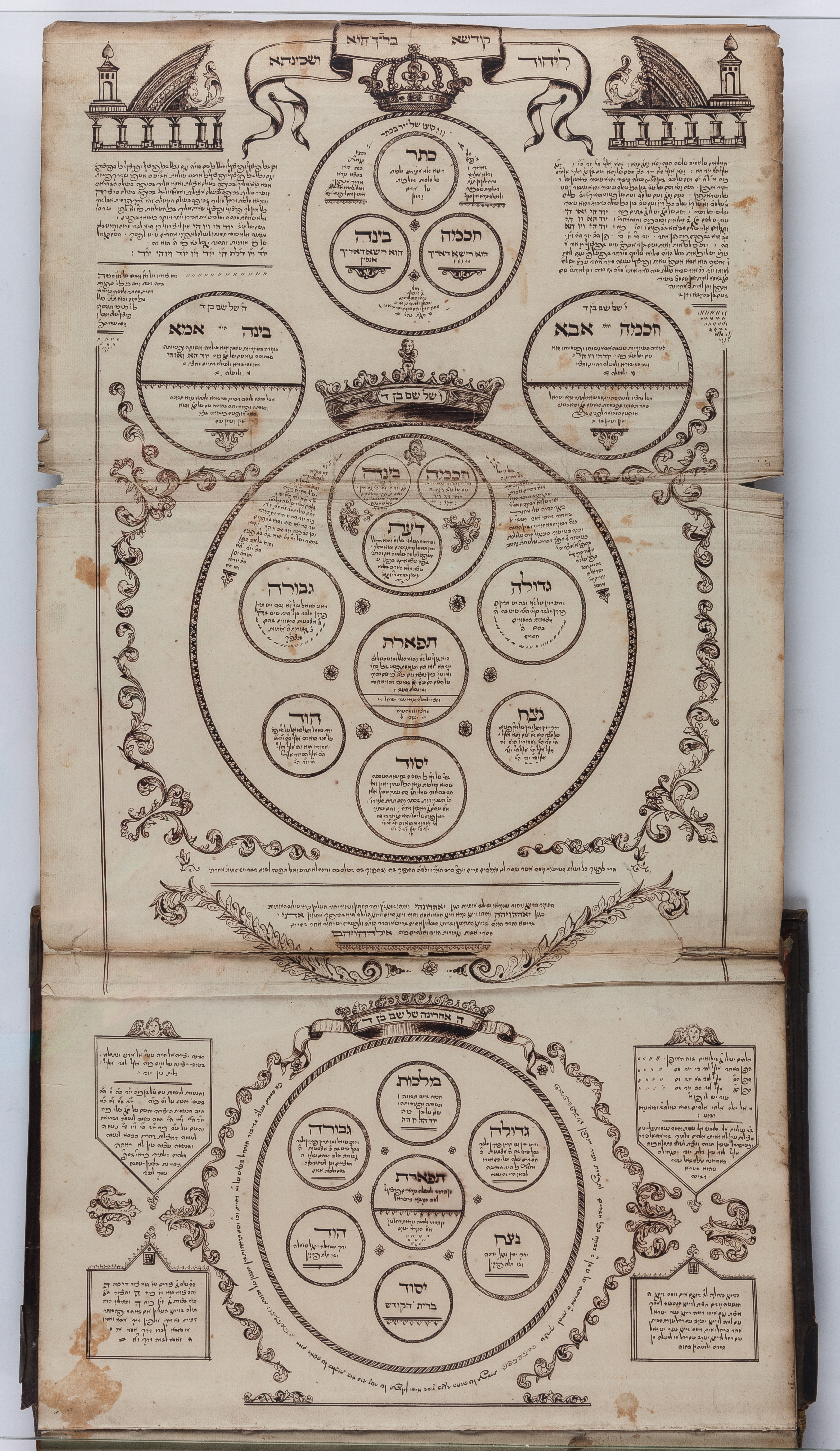
SummaryThis 1730 luxury paper foldout, preserved in the Jewish Museum in Prague (Prague, Jewish Museum, Ms. 69), is a mature and richly illustrated witness of the Ilan of Expanded Names (N) module. Copied and illustrated by the self-described “scribe and artist” Israel ben Asher Buchbinder, the ilan serves as the concluding element of a Poppers edition of Ḥayyim Vital’s ‘Eẓ Ḥayyim. The manuscript represents the stage where Buchbinder’s exuberant rococo style attained its full artistic form, and it is reminiscent of printed models. The ilan features sophisticated ornamentation, such as spiraling vines, architectural ornaments accompanied by carved masks, and cherubic heads set atop folded angel wings. Regal tiaras can be seen crowning the three central circles of the diagram. Beyond the primary schema, the manuscript includes unique visualizations characteristic of Buchbinder’s mature work, such as a human head inside which sefirot and the letters of Sefer yeẓirah are marked, and a diagram representing hands opened like a book. These elaborate flourishes indicate the progressive beautification of the genre in the eighteenth century.
Further Information
Research LiteratureJ. H. Chajes, The Kabbalistic Tree (University Park, PA: Penn State University Press, 2022), 160–161.
Find more IlanotSearch for Ilanot on this Manuscript