AMPLE Catalogue of
Ilan Diagrams

Munich (Germany), Bayerische Staatsbibliothek: Cod.hebr. 449

About the Ilan

TextGrid URI of the Editiontextgrid:4b0zv

Surfaces of the Ilan

Recto

(not publicly available)

About the Manuscript

Identifiers and Titles

IdentifierMunich (Germany), Bayerische Staatsbibliothek: Cod.hebr. 449
Primary Manuscript TitlesZacuto-แบ’emaแธฅ Arik and the Enrobings Ilan
Alternative Manuscript TitlesMunich, BSB, Cod.hebr. 449

Manuscript History

Origin
Date Information17th century

Physical Description

MaterialParchment ๐Ÿ›ˆTranslucent or opaque material made from calf, sheep, or goat skin which has been limed, dehaired, scraped, and dried under tension to produce a thin, strong material for writing, bookbinding, or other uses. For finer quality calf parchment, use "vellum." The terms parchment and vellum sometimes have been and still are both confused and used interchangeably. ๐Ÿ”Ž๏ธŽSearch for Ilanot with this Material
FormRotulus ๐Ÿ›ˆA roll of parchment or paper unrolled vertically for reading. ๐Ÿ”Ž๏ธŽSearch for Ilanot with this Form
Dimensions Description70 ร— 32
Hand DescriptionAshkenazic

Content Description

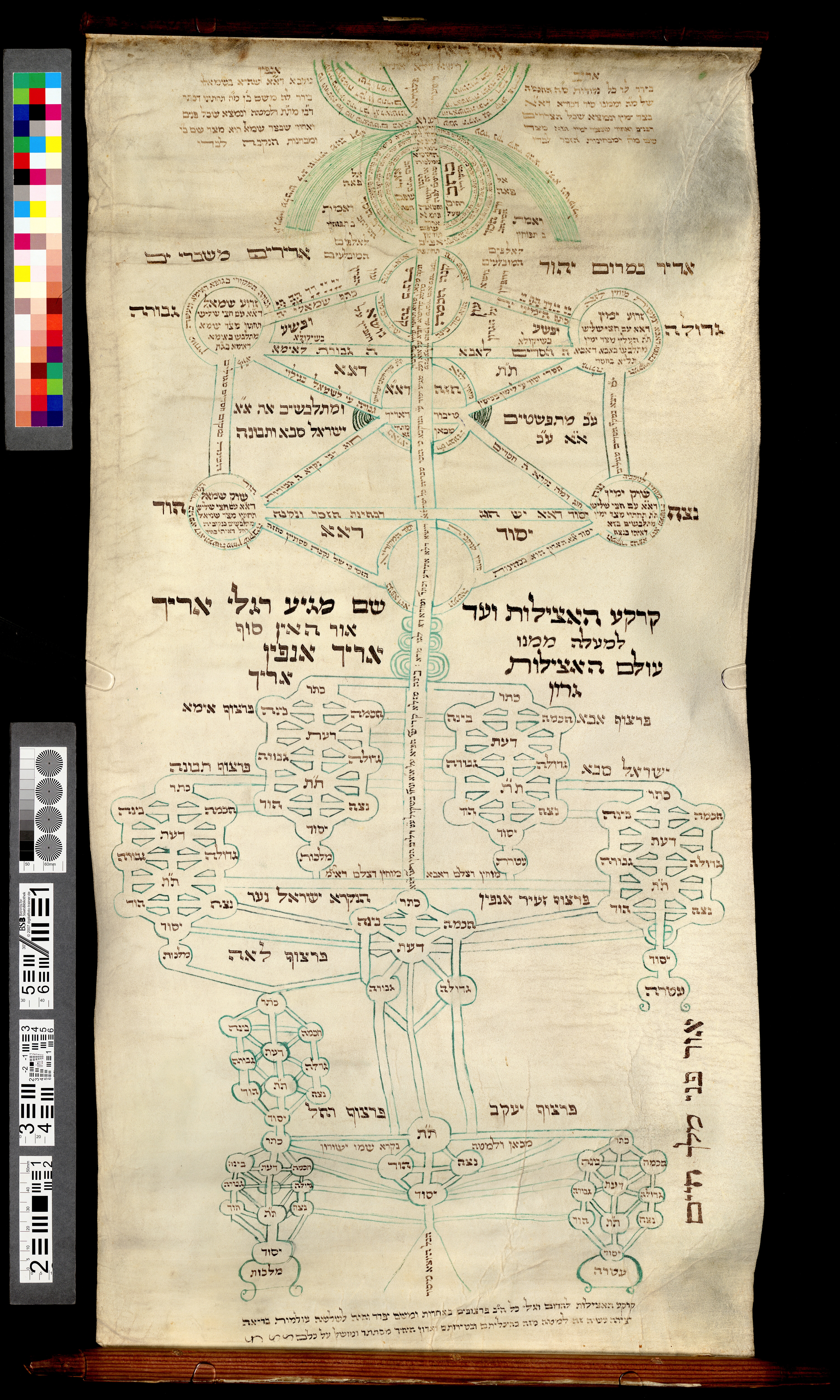
SummaryThis seventeenth-century Ashkenazi rotulus is a seminal witness of the Zacuto-แบ’emaแธฅ (Z) type. It is of particular historical significance as it bears the closest resemblance to the foldout engravings in Christian Knorr von Rosenrothโ€™s Kabbala Denudata, sharing distinctive graphical anomalies and textual variants reflected in Knorrโ€™s Latin translations. The manuscript is executed in a unique style, featuring diagrammatic elements drawn in green ink that stands in contrast to the rest of the inscriptions, which were penned in a seventeenth-century Ashkenazi square script. The ilan consists of an elegant splicing of Moses Zacutoโ€™s Arikh Anpin diagram (Z13) and Jacob แบ’emaแธฅโ€™s visualization of the Enrobings (Z14). A continuous vertical channel runs the entire length of the parchment, flowing from the intake funnel for the light of Ein Sof at the top of the ilan to the outtake funnel emerging from Yesod at the bottom.

Further Information

Research LiteratureJ. H. Chajes, The Kabbalistic Tree (University Park, PA: Penn State University Press, 2022), 40โ€“41.

Facsimiles

Recto

(not publicly available)

Other Formats

You may also download this record in one of the following formats:

Munich (Germany), Bayerische Staatsbibliothek: Cod.hebr. 449

About the Ilan

TextGrid URI of the Editiontextgrid:4b0zv

Surfaces of the Ilan

Recto

(not publicly available)

About the Manuscript

Identifiers and Titles

IdentifierMunich (Germany), Bayerische Staatsbibliothek: Cod.hebr. 449
Primary Manuscript TitlesZacuto-แบ’emaแธฅ Arik and the Enrobings Ilan
Alternative Manuscript TitlesMunich, BSB, Cod.hebr. 449

Manuscript History

Origin
Date Information17th century

Physical Description

MaterialParchment ๐Ÿ›ˆTranslucent or opaque material made from calf, sheep, or goat skin which has been limed, dehaired, scraped, and dried under tension to produce a thin, strong material for writing, bookbinding, or other uses. For finer quality calf parchment, use "vellum." The terms parchment and vellum sometimes have been and still are both confused and used interchangeably. ๐Ÿ”Ž๏ธŽSearch for Ilanot with this Material
FormRotulus ๐Ÿ›ˆA roll of parchment or paper unrolled vertically for reading. ๐Ÿ”Ž๏ธŽSearch for Ilanot with this Form
Dimensions Description70 ร— 32
Hand DescriptionAshkenazic

Content Description

SummaryThis seventeenth-century Ashkenazi rotulus is a seminal witness of the Zacuto-แบ’emaแธฅ (Z) type. It is of particular historical significance as it bears the closest resemblance to the foldout engravings in Christian Knorr von Rosenrothโ€™s Kabbala Denudata, sharing distinctive graphical anomalies and textual variants reflected in Knorrโ€™s Latin translations. The manuscript is executed in a unique style, featuring diagrammatic elements drawn in green ink that stands in contrast to the rest of the inscriptions, which were penned in a seventeenth-century Ashkenazi square script. The ilan consists of an elegant splicing of Moses Zacutoโ€™s Arikh Anpin diagram (Z13) and Jacob แบ’emaแธฅโ€™s visualization of the Enrobings (Z14). A continuous vertical channel runs the entire length of the parchment, flowing from the intake funnel for the light of Ein Sof at the top of the ilan to the outtake funnel emerging from Yesod at the bottom.

Further Information

Research LiteratureJ. H. Chajes, The Kabbalistic Tree (University Park, PA: Penn State University Press, 2022), 40โ€“41.