Jerusalem (Israel), Meir Benayahu Collection
About the Ilan
TextGrid URI of the Editiontextgrid:4b1g4
FamiliesZacuto-Ẓemaḥ (Lurianic) 🔎︎Search for Ilanot in this Family
Surfaces of the Ilan
Recto
About the Manuscript
Identifiers and Titles
IdentifierJerusalem (Israel), Meir Benayahu Collection Ilan
Primary Manuscript TitlesZacuto-Ẓemaḥ Arik and the Enrobings Ilan
Manuscript History
Origin
Date Information17th century
Physical Description
MaterialParchment 🛈Translucent or opaque material made from calf, sheep, or goat skin which has been limed, dehaired, scraped, and dried under tension to produce a thin, strong material for writing, bookbinding, or other uses. For finer quality calf parchment, use "vellum." The terms parchment and vellum sometimes have been and still are both confused and used interchangeably. 🔎︎Search for Ilanot with this Material
Dimensions Description70 × 32
Content Description
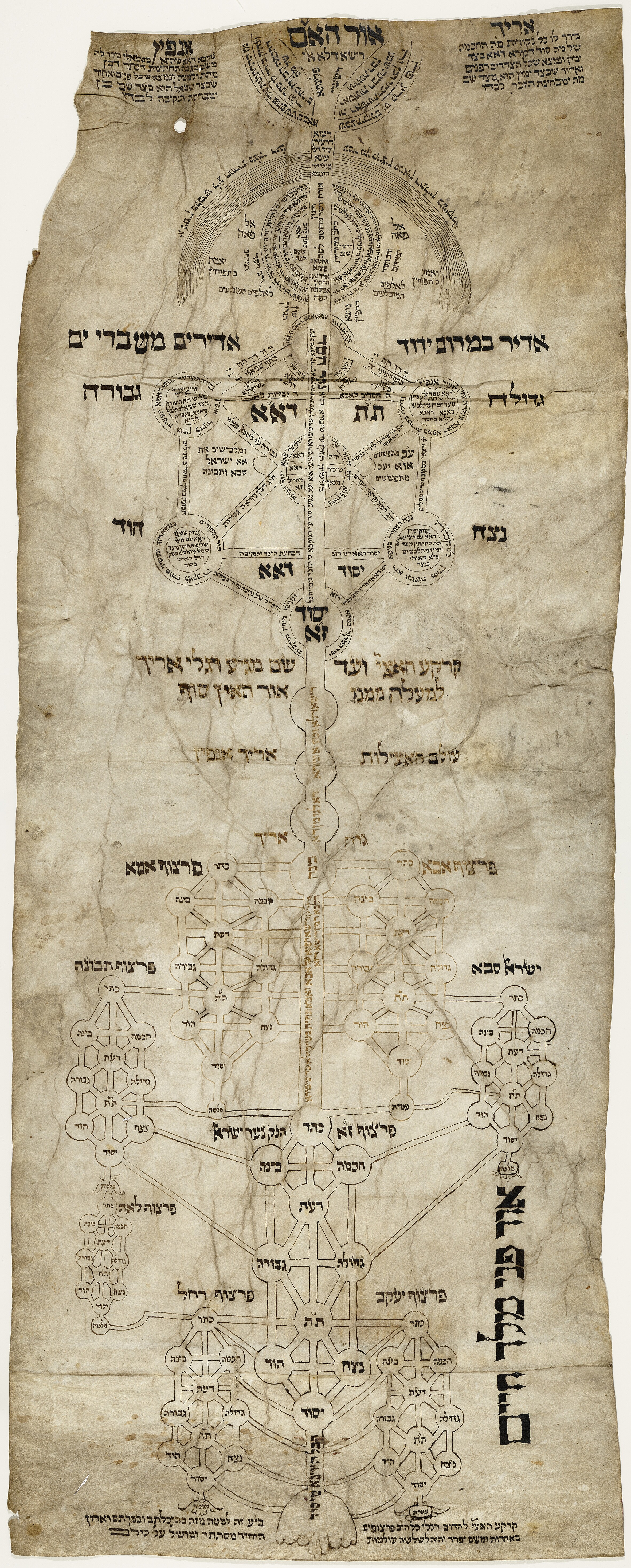
SummaryThis seventeenth-century Zacuto-Ẓemaḥ (Z) ilan, preserved in the Meir Benayahu Collection in Jerusalem, represents a seminal stage in the evolution of the Lurianic ilan. It elegantly splices together two foundational diagrammatic modules: Moses Zacuto’s Arikh Anpin (Z13) and Jacob Ẓemaḥ’s visualization of the Enrobings (Z14). The manuscript exhibits a distinctive combination of Ashkenazi and Sephardi square scripts, featuring a particularly large and discordant medieval Ashkenazi square inscription. Textual analysis reveals that this ilan shares specific corruptions with the decorated Trinity Scroll in Cambridge (Cambridge, Trinity College, Scroll F.11.18), indicating they likely derive from a common source.
Further Information
Research LiteratureJ. H. Chajes, The Kabbalistic Tree (University Park, PA: Penn State University Press, 2022), 119.
Find more IlanotSearch for Ilanot on this Manuscript