Jerusalem, NLI, Ms. Heb. 4=9792
About the Ilan
TextGrid URI of the Editiontextgrid:3w9wk
FamiliesClassical ilan (Classical) 🔎︎Search for Ilanot in this Family
Surfaces of the Ilan
Recto
About the Manuscript
Identifiers and Titles
IdentifierJerusalem (Israel), The National Library of Israel: Ms. Heb. 9792=4
Alternative IdentifiersTel Aviv, GFC, Ms. 083.011.002
Primary Manuscript TitlesClassical Ilan
Alternative Manuscript TitlesJerusalem, NLI, Ms. Heb. 4=9792
NLI ID990033789540205171
Manuscript History
Origin
Date Information17th-century
Provenance
OwnerGross, William L. (former owner)
Provenance PlacesTel Aviv (Israel)
Physical Description
MaterialPaper 🛈Refers generally to all types of thin matted or felted sheets or webs of fiber formed and dried on a fine screen from a pulpy water suspension. The fibers may be animal, such as hair, silk or wool, or mineral, such as asbestos, or synthetic. However most paper is made from cellulosic plant fiber, such as from wood pulp, grass, cotton, linen, and straw. 🔎︎Search for Ilanot with this Material
Dimensions Description57.8 × 43
Languages Used
Main LanguageRabbinic Hebrew 🛈https://ilanot.org/voc/languages/he-x-rabbinic 🔎︎Search for Ilanot with this Language
Content Description
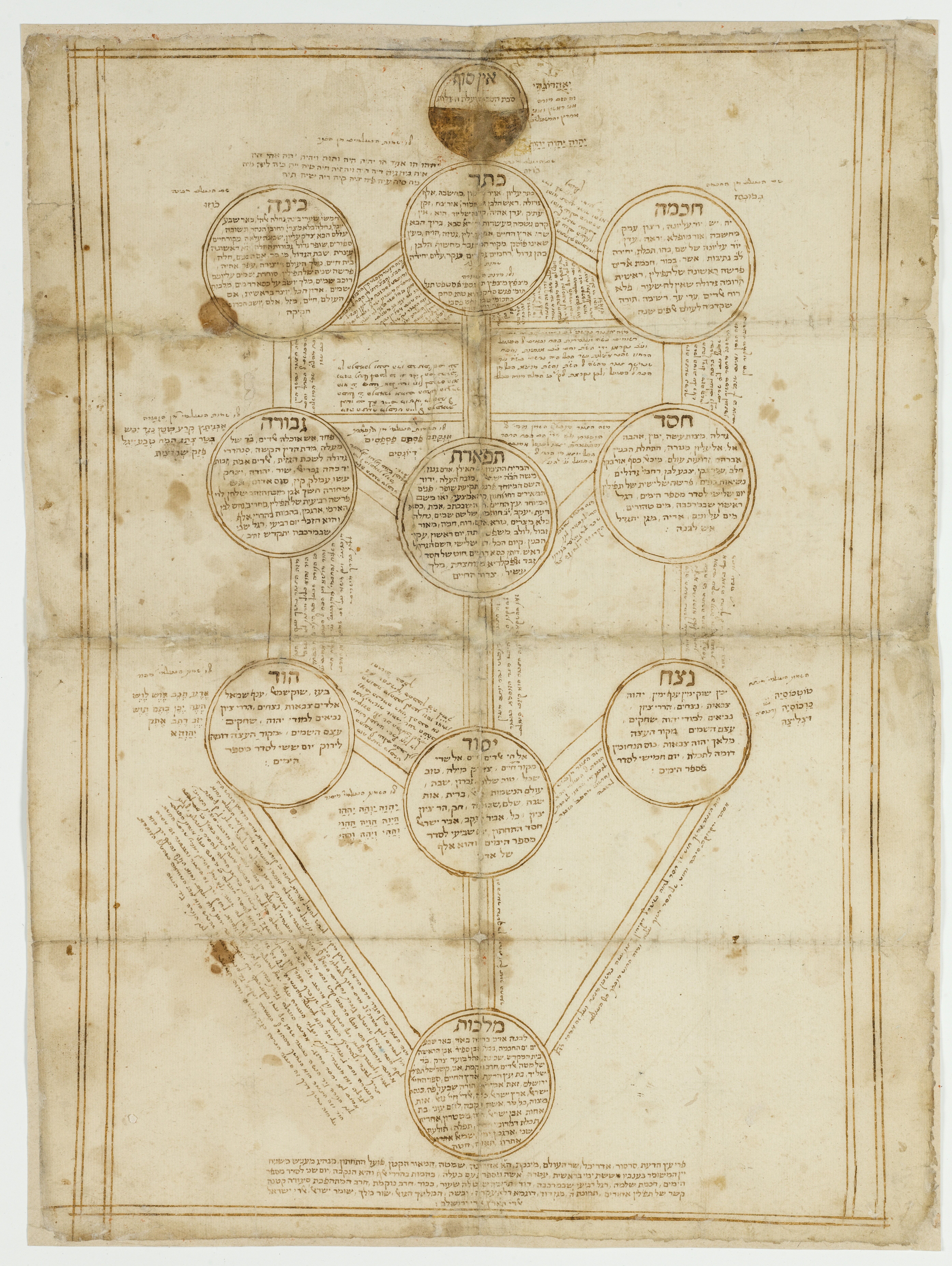
SummaryThis seventeenth-century Italian copy of a classical ilan that goes back to the fourteenth century demonstrates the ongoing relevance of such artifacts even in an era typically presumed to have been dominated by the Lurianic Kabbalah. It preserves the core content associated with the genre from its inception: names and appellations associated with each of the ten sefirot inscribed in the medallions, networking principles inscribed in or adjacent to the channels that connect the sefirot. Ein Sof is represented as a medallion above the arboreal figure, its bottom half blackened to signify its impenetrability to human thought.
Colophon "נשלם בע"ה יום ה' י"ד ימים לחדש שבט שנת הקטין י'ה'ו'ד'ה' ל'י'ב' ב'ן' א'ש'ר' א'נשי'ל כ"ץ [תרל"ו]"
The scribe wrote his father's name three times and erased two of them.
The scribe wrote his father's name three times and erased two of them.
Further Information
Research LiteratureJ. H. Chajes, The Kabbalistic Tree (University Park, PA: Penn State University Press, 2022), 2-3, 372.
Find more IlanotSearch for Ilanot on this Manuscript