Munich, BSB, Cod.hebr. 119
About the Ilan
TextGrid URI of the Editiontextgrid:3wcbp
FamiliesClassical ilan (Classical) 🔎︎Search for Ilanot in this Family
Surfaces of the Ilan
Recto
About the Manuscript
Identifiers and Titles
IdentifierMunich (Germany), Bavarian State Library: Munich, BSB, Cod.hebr. 119
Alternative IdentifiersMunich (Germany), Bavarian State Library: Cod.hebr. 119
Primary Manuscript TitlesClassical Ilan
Alternative Manuscript TitlesMunich, BSB, Cod.hebr. 119
NLI ID990000698680205171
Manuscript History
Origin
ContributorsIbn Polia, Shem Tov ben Yaakov (Scribe)
Date Information15th century
Provenance
Provenance Information "רפאל כמ' אברהם מילמירנדולה זלה"ה קניתיהו בטירווישי מן כמר אשר אשכנזי בן כמר' יעקב המכונה פונפילא יציאת אטוברו רנ"ג ליצ'"
(page 23r)
(page 23r)
OwnerMirandola, Raphael ben Abraham (former owner)
OwnerPonfila, Asher ben Jacob (former owner)
OwnerBavarian State Library (current owner)
Provenance PlacesMunich (Germany)
Physical Description
MaterialPaper 🛈Refers generally to all types of thin matted or felted sheets or webs of fiber formed and dried on a fine screen from a pulpy water suspension. The fibers may be animal, such as hair, silk or wool, or mineral, such as asbestos, or synthetic. However most paper is made from cellulosic plant fiber, such as from wood pulp, grass, cotton, linen, and straw. 🔎︎Search for Ilanot with this Material
FormCodex 🛈Ancient manuscripts generally taking the form of the modern book: bound leaves of paper or parchment with information inscribed on both faces, attached at a center fold. For books that are printed rather than inscribed, before 1501, use 'incunabula.' 🔎︎Search for Ilanot with this Form
Number of Pages25
Dimensions Description27.2 × 20.8
Hand DescriptionItalian
Languages Used
Main LanguageRabbinic Hebrew 🛈https://ilanot.org/voc/languages/he-x-rabbinic 🔎︎Search for Ilanot with this Language
Additional LanguagesRabbinic Hebrew 🛈https://ilanot.org/voc/languages/he-x-rabbinic 🔎︎Search for Ilanot with this Language
Content Description
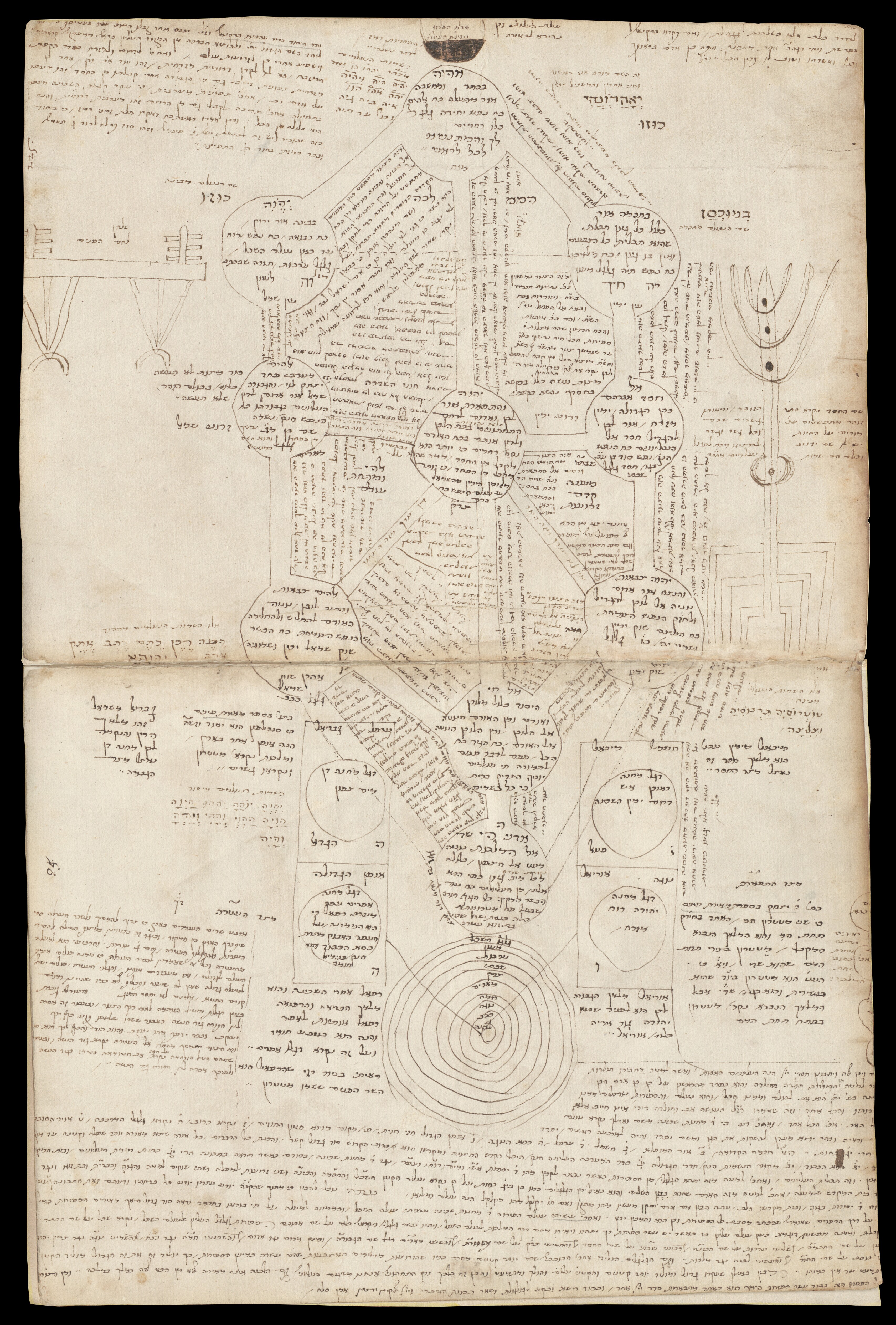
SummaryThe classical parchment behind This ilan, drafted in semicursive script by an Italian scribe ca. 1500, is easily discerned. A sefirotic tree dominates the double page, flanked by the menorah and table, which are never found in the simple epistemic images of the tree that merely remind the reader of its basic structure. Their evocative presence communicates the capacity of the ilan to summon and hold divine immanence. Another indication of the ambitious program of the Munich codex ilan is to be found in its representation of the realm beneath the sefirotic tree. The lowest sefirah of Malkhut appears as if docking atop the celestial spheres, which are represented in accord with astronomical convention as concentric circles. In this seemingly ad hoc sketch—an impression confirmed by the scribe’s attestations to elements in need of revision—we find texts written at every conceivable angle in and around the diagram. The visual confusion also reflects the fact that the scribe has taken an additive approach to his work. Having compressed one ilan parchment to fit these facing pages, he then supplemented it with material he found on others, to which he refers when noting their divergences from his base model. “I saw in another yeri‘ah” is a recurring inscription on these cramped pages. The scribe has supplemented texts from Meirat ‘einayim and Recanati as well, perhaps culled from another ilan. The jumble is a snapshot of the fifteenth-century Italian kabbalistic bookshelf or, at the very least, of its representation in the ilanot at this scribe’s disposal. The miscellany contains materials going back to 1404, but this back-matter ilan was likely executed later in the century. The codex was in the collection of Egidio da Viterbo and includes his marginal notes.
Colophon"אני שם טוב בן החכם ר' יעקב הספרדי אבן פולייא תנצב"ה כתבתי זה הספר לעצמי בעיר מודון ... וסיימתיו בחדש כסליו בארבעה ימים בו שנת הקס"ה".
(page 24r)
(page 24r)
Further Information
Research LiteratureM. Steinschneider, Die hebraeischen Handschriften der K. Hof-und Staatsbibliothek in Muenchen (Muenchen 1895).
J. H. Chajes, The Kabbalistic Tree (University Park, PA: Penn State University Press, 2022), 40–41.
Maximilian de Molière, “Studies in the Christian Hebraist Library of Johann Albrecht Widmanstetter” (PhD diss., Ludwig-Maximilians-Universität München, 2021).
J. H. Chajes, The Kabbalistic Tree (University Park, PA: Penn State University Press, 2022), 40–41.
Maximilian de Molière, “Studies in the Christian Hebraist Library of Johann Albrecht Widmanstetter” (PhD diss., Ludwig-Maximilians-Universität München, 2021).
Find more IlanotSearch for Ilanot on this Manuscript