Jerusalem, NLI, Ms. Heb. 4=9795
About the Ilan
TextGrid URI of the Editiontextgrid:48z3q
FamiliesPoppers (Lurianic) 🔎︎Search for Ilanot in this Family
Surfaces of the Ilan
Recto
About the Manuscript
Identifiers and Titles
IdentifierJerusalem (Israel), The National Library of Israel: Ms. Heb. 9795=4
Alternative IdentifiersTel Aviv, GFC, Ms. 028.012.015
Primary Manuscript TitlesPoppers Ilan
Alternative Manuscript TitlesJerusalem, NLI, Ms. Heb. 4=9795
NLI ID997012314165205171
Manuscript History
Origin
CreatorMeir Poppers 🔎︎Search for Ilanot by this Creator
Date Informationca. 1700
Physical Description
MaterialParchment 🛈Translucent or opaque material made from calf, sheep, or goat skin which has been limed, dehaired, scraped, and dried under tension to produce a thin, strong material for writing, bookbinding, or other uses. For finer quality calf parchment, use "vellum." The terms parchment and vellum sometimes have been and still are both confused and used interchangeably. 🔎︎Search for Ilanot with this Material
FormRotulus 🛈A roll of parchment or paper unrolled vertically for reading. 🔎︎Search for Ilanot with this Form
Dimensions Description1520 × 560
Hand DescriptionAshkenazic
Languages Used
Main LanguageRabbinic Hebrew 🛈https://ilanot.org/voc/languages/he-x-rabbinic 🔎︎Search for Ilanot with this Language
Content Description
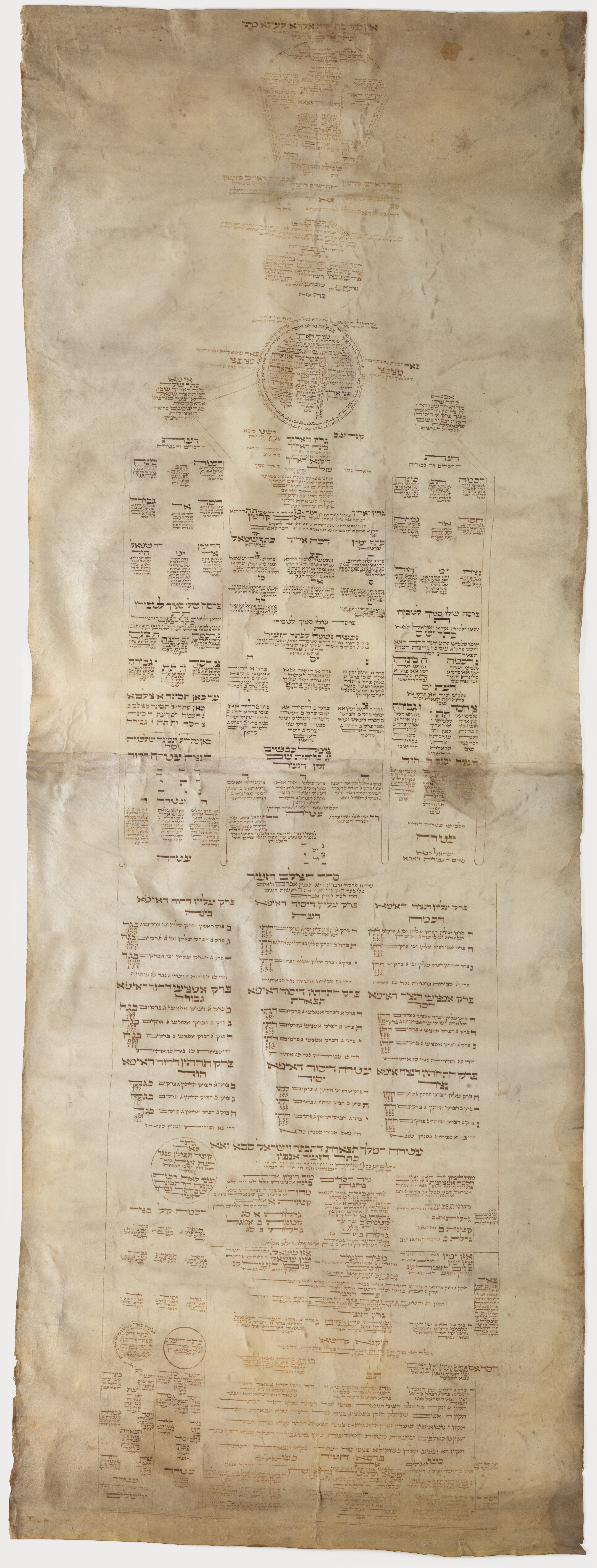
SummaryThis ilan, copied around 1700 by a scribe of German or Bohemian origin, is one of only two known copies that exclusively preserve Meir Poppers’ original ilan. The second, copied by Behr Eibeschütz Perlhefter (ca. 1650–ca. 1713), is held in the Magnes Collection of Jewish Art and Life at the University of California (Berkeley, Magnes Collection, acc. no. 67.1.11.3). The early Hammerschlag ilan (Jerusalem, NLI, Ms. Heb. 4=9794) might be considered a third, were it not for its modest modifications. The ilan features a symmetrical, tabular design that highlights the right, left, and center of kabbalistic cosmology. Its simple, unornamented style reflects the ilan’s original pedagogical purpose, as described by Poppers himself.
Further Information
Research LiteratureJ. H. Chajes, The Kabbalistic Tree (University Park, PA: Penn State University Press, 2022), 140–144, 349.
Find more IlanotSearch for Ilanot on this Manuscript