Vatican City, BAV, Ms. Borg. ebr. 21
About the Ilan
TextGrid URI of the Editiontextgrid:3wbfq
ContextHermeneutical 🛈The usage context of the diagram is for hermeneutical purposes. 🔎︎Search for Ilanot with this Context
FamiliesClassical ilan (Classical) 🔎︎Search for Ilanot in this Family
Surfaces of the Ilan
Recto
About the Manuscript
Identifiers and Titles
IdentifierVatican City (Vatican City State), Vatican Library: Ms. Borg ebr. 21
Primary Manuscript TitlesSmall Parchment
יריעה קטנה
Alternative Manuscript TitlesVatican City, BAV, Ms. Borg. ebr. 21
NLI ID990001129970205171
Manuscript History
Origin
Date Information17th century
Provenance
OwnerVatican Library (current owner)
Provenance PlacesVatican City (Vatican City State)
Physical Description
MaterialParchment 🛈Translucent or opaque material made from calf, sheep, or goat skin which has been limed, dehaired, scraped, and dried under tension to produce a thin, strong material for writing, bookbinding, or other uses. For finer quality calf parchment, use "vellum." The terms parchment and vellum sometimes have been and still are both confused and used interchangeably. 🔎︎Search for Ilanot with this Material
Number of Pages1
Dimensions Description55.5 × 34.5
Hand DescriptionSquare
Languages Used
Main LanguageRabbinic Hebrew 🛈https://ilanot.org/voc/languages/he-x-rabbinic 🔎︎Search for Ilanot with this Language
Content Description
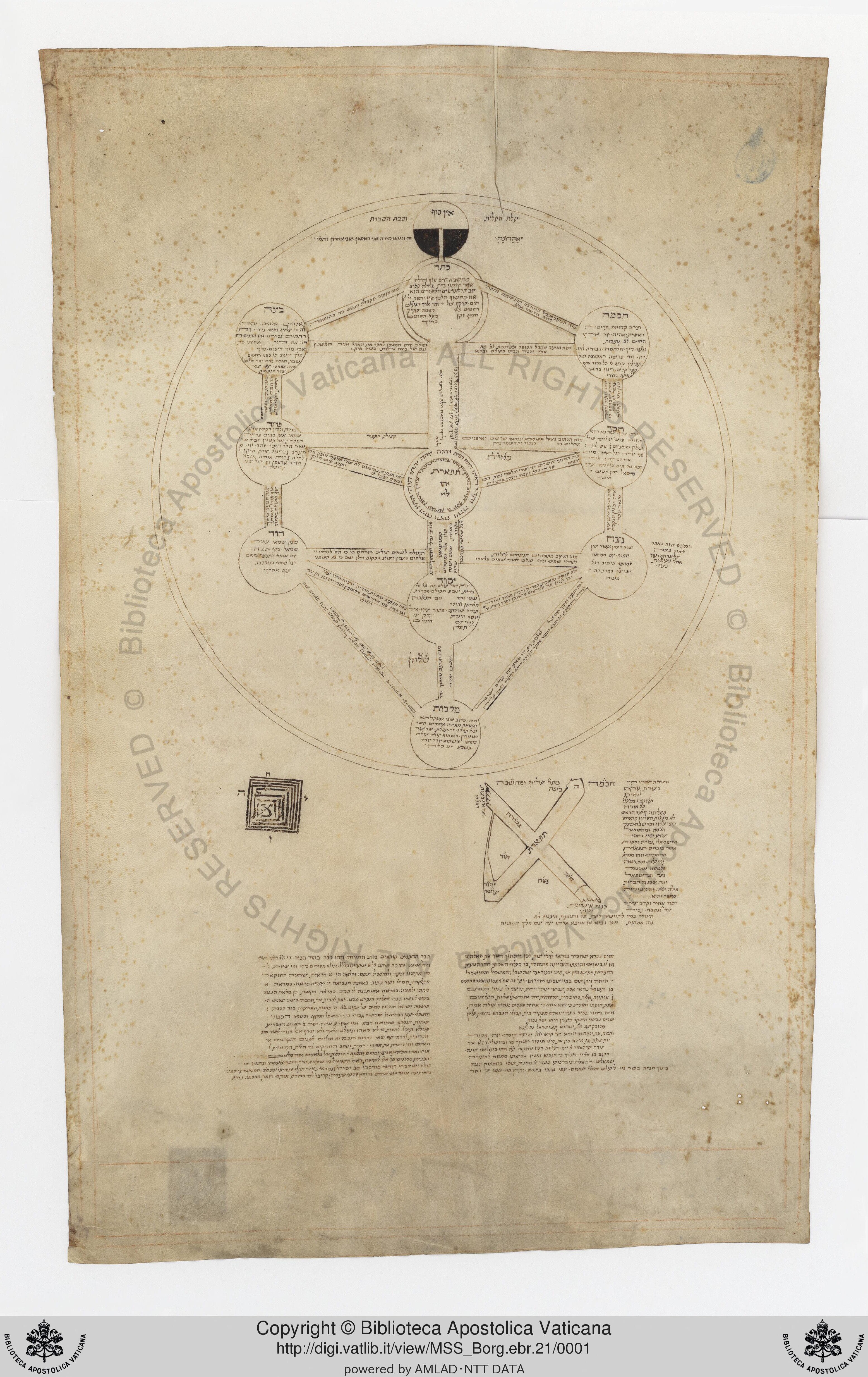
SummaryThis is an Italian copy of a Small Parchment, a type of classical ilan that goes back to the fourteenth century. The fact that it was copied in the seventeenth century demonstrates the ongoing relevance of such artifacts even in an era typically presumed to have been dominated by the Lurianic Kabbalah. It presents the core content associated with the Small Parchment family: names and appellations associated with each of the ten sefirot inscribed in the medallions, networking principles inscribed in or adjacent to the channels that connect the sefirot. Ein Sof is represented as a medallion above the arboreal figure, its bottom half blackened to signify its impenetrability to human thought. On this copy, the Menorah and Shewbread table are indicated by words alone rather than the representational drawings seen in many other Small Parchments. The clear channel that connects the top half of Ein Sof to the highest sefirah of Keter is a distinctive graphical feature of this exemplar.
A rectangular double-lined frame follows the cut of the parchment and a double-lined circle frames the central arboreal figure. Though likely intended to serve as an organizational device to distinguish the tree from the material below it, the circle may have also been intended symbolically to signal the realm of the holy.
Two additional diagrams appear in the substantial space that remained beneath the arboreal figure. To the left, ten sefirot are represented as concentric circles formed of the acrostics of their respective names. This diagram is known from the ca.1300 work Meirat 'einayim of R. Isaac of Acre. To the right, the ten sefirot are represented in the form of an alef, the first letter of the Hebrew alphabet that also has the numerical value of one. Both of these representations of the sefirot are among the earliest and enduring in the history of Kabbalah.
The use of Italian[?] square script and particular scribal mistakes suggest the possibility that the copy was made by a Christian.
A rectangular double-lined frame follows the cut of the parchment and a double-lined circle frames the central arboreal figure. Though likely intended to serve as an organizational device to distinguish the tree from the material below it, the circle may have also been intended symbolically to signal the realm of the holy.
Two additional diagrams appear in the substantial space that remained beneath the arboreal figure. To the left, ten sefirot are represented as concentric circles formed of the acrostics of their respective names. This diagram is known from the ca.1300 work Meirat 'einayim of R. Isaac of Acre. To the right, the ten sefirot are represented in the form of an alef, the first letter of the Hebrew alphabet that also has the numerical value of one. Both of these representations of the sefirot are among the earliest and enduring in the history of Kabbalah.
The use of Italian[?] square script and particular scribal mistakes suggest the possibility that the copy was made by a Christian.
Further Information
Research LiteratureJ. H. Chajes, The Kabbalistic Tree (University Park, PA: Penn State University Press, 2022), 372.
Benjamin Richler, ed., Hebrew Manuscripts in the Vatican Library: Catalogue, palaeographical and codicological descriptions by Malachi Beit-Arié and Nurit Pasternak (Città del Vaticano: Biblioteca Apostolica Vaticana, 2008).
Stephen Evodius Assemanus and Joseph Simonius Assemanus, Bibliothecae Apostolicae Vaticanae codicum manuscriptorum catalogus, vol. 1, Codices ebraicos et samaritanos (Romae, 1756), 409–455.
Eliezer Baumgarten, and Uri Safrai, “From This Pathway Jacob Ascends to the Neck: On Movement and Change Within the Kabbalistic Tree,” (Hebrew) Mabatim 3 (2024): 168–88. ["מזה הנתיב עולה יעקב עד הצואר" – על תנועה ושינוי בתוך האילן הקבלי]
J. H. Chajes, “‘A Secret Particularly Obscure’: The Menorah and the Sacred Space of Classical Ilanot (Kabbalistic Trees),” in The Menorah and the Seven-branched Candelabrum, ed. Andrea Worm, and Maria Streicher (Berlin: De Gruyter, 2025): 307–39.
Benjamin Richler, ed., Hebrew Manuscripts in the Vatican Library: Catalogue, palaeographical and codicological descriptions by Malachi Beit-Arié and Nurit Pasternak (Città del Vaticano: Biblioteca Apostolica Vaticana, 2008).
Stephen Evodius Assemanus and Joseph Simonius Assemanus, Bibliothecae Apostolicae Vaticanae codicum manuscriptorum catalogus, vol. 1, Codices ebraicos et samaritanos (Romae, 1756), 409–455.
Eliezer Baumgarten, and Uri Safrai, “From This Pathway Jacob Ascends to the Neck: On Movement and Change Within the Kabbalistic Tree,” (Hebrew) Mabatim 3 (2024): 168–88. ["מזה הנתיב עולה יעקב עד הצואר" – על תנועה ושינוי בתוך האילן הקבלי]
J. H. Chajes, “‘A Secret Particularly Obscure’: The Menorah and the Sacred Space of Classical Ilanot (Kabbalistic Trees),” in The Menorah and the Seven-branched Candelabrum, ed. Andrea Worm, and Maria Streicher (Berlin: De Gruyter, 2025): 307–39.
Find more IlanotSearch for Ilanot on this Manuscript
About the Edition
EditorsEliezer Baumgarten 🔎︎Search for Ilanot Editions with this Editor or Contributor
Josef H. Chajes 🔎︎Search for Ilanot Editions with this Editor or Contributor
Maximilian de Molière 🔎︎Search for Ilanot Editions with this Editor or Contributor
Maximilian de Molière 🔎︎Search for Ilanot Editions with this Editor or Contributor
Facsimiles
Recto