Munich, BSB, Cod.hebr. 448
About the Ilan
TextGrid URI of the Editiontextgrid:3wbt4
FamiliesClassical ilan (Classical) 🔎︎Search for Ilanot in this Family
Surfaces of the Ilan
Recto
About the Manuscript
Identifiers and Titles
IdentifierMunich (Germany), Bavarian State Library: Cod.hebr. 448
Primary Manuscript TitlesClassical Ilan
Alternative Manuscript TitlesMunich, BSB, Cod.hebr. 448
NLI ID990001284980205171
Manuscript History
Origin
CreatorFrancesco Parnas 🔎︎Search for Ilanot by this Creator
Date Informationca. 1537
Creation PlacesFederal Republic of Germany (Germany)
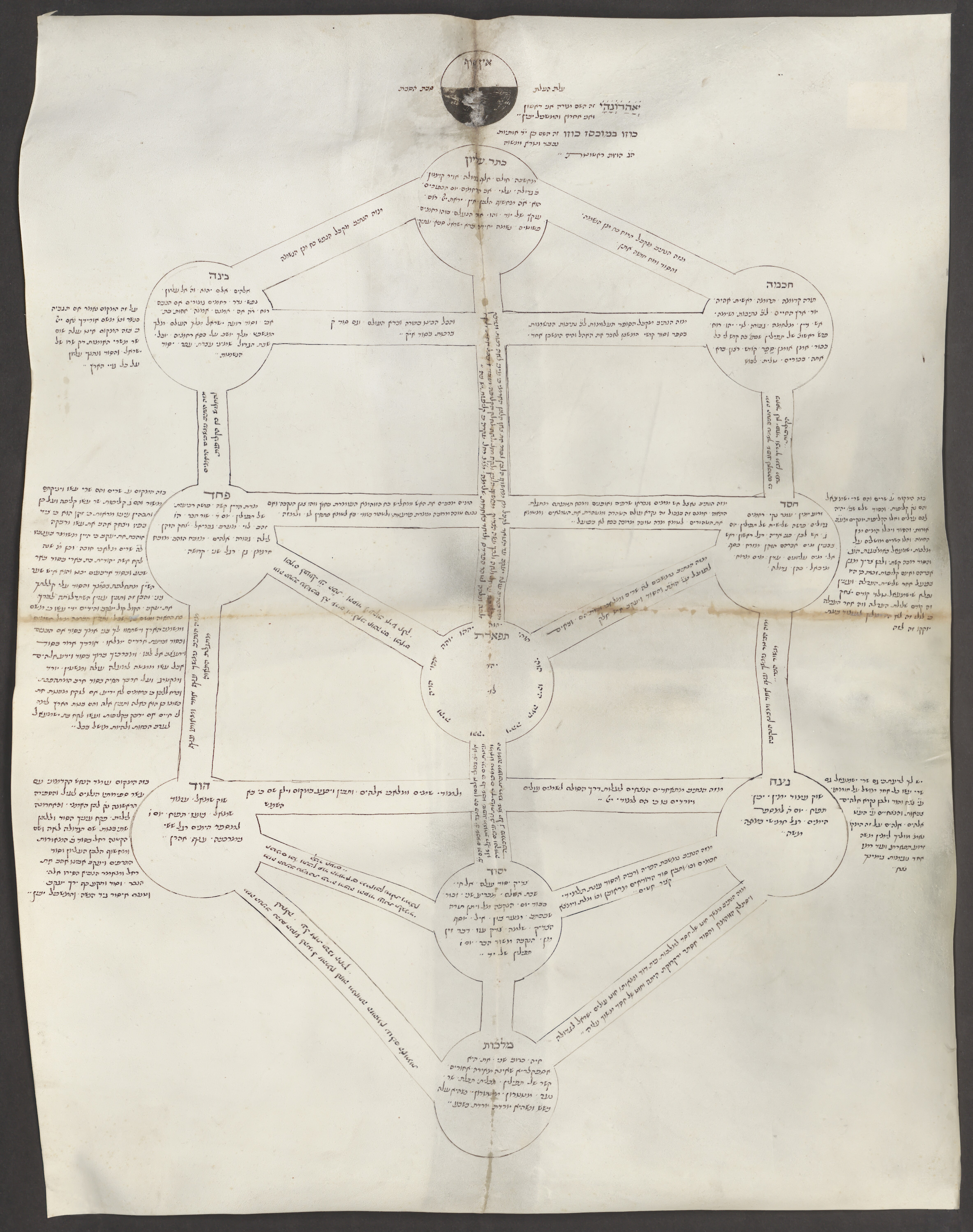
Creation Event DescriptionCopied by Francesco Parnas for Johann Albrecht Widmanstetter around 1537. During that period, Parnas was occupied with copying a number of kabbalistic manuscripts for Widmanstetter, including zoharic materials (Cod. hebr. 217-219).
Provenance
OwnerBavarian State Library (current owner)
Provenance PlacesMunich (Germany)
Physical Description
MaterialParchment 🛈Translucent or opaque material made from calf, sheep, or goat skin which has been limed, dehaired, scraped, and dried under tension to produce a thin, strong material for writing, bookbinding, or other uses. For finer quality calf parchment, use "vellum." The terms parchment and vellum sometimes have been and still are both confused and used interchangeably. 🔎︎Search for Ilanot with this Material
FormSheet 🛈A leaf is a single sheet of paper or parchment, recto and verso, making two pages of a book; the basic bibliographical unit of a book. 🔎︎Search for Ilanot with this Form
Dimensions Description49 × 38
Hand DescriptionAshkenazic
Languages Used
Main LanguageRabbinic Hebrew 🛈https://ilanot.org/voc/languages/he-x-rabbinic 🔎︎Search for Ilanot with this Language
Content Description
SummaryCod. hebr. 448 is a single parchment sheet classical ilan. According to Maximilian de Molière, it was likely copied by Francesco Parnas for Johann Albrecht Widmanstetter around 1537. During that period, Parnas was occupied with copying a number of kabbalistic manuscripts for Widmanstetter, including zoharic materials (Cod. hebr. 217-219). The ilan is a relatively straight-forward copy of a type that by then had been in circulation for at least a century. Cod.hebr. 448 is also of the same family as the classical ilan that Knorr von Rosenroth included in the in the second apparatus of the first volume of “Kabbala denudata” under the title “Clavis sublimioris Kabbalae, de ordine divinorum Nominum pro resolutione difficiliorum Aenigmatum Libri Sohar”.
Further Information
Research LiteratureJ. H. Chajes, The Kabbalistic Tree (University Park, PA: Penn State University Press, 2022), 372, 386.
Ernst Roth, Verzeichnis der orientalischen Handschriften in Deutschland, vol. 6, pt. 2, Hebräische Handschriften (Wiesbaden: Franz Steiner, 1965), no. 356.
De Molière, Maximilian. Confronting Kabbalah: Studies in the Christian Hebraist Library of Johann Albrecht Widmanstetter. Supplements to The Journal of Jewish Thought and Philosophy 36. Leiden: Brill, 2024. Pages 114, 291–292, 531–532.
Ernst Roth, Verzeichnis der orientalischen Handschriften in Deutschland, vol. 6, pt. 2, Hebräische Handschriften (Wiesbaden: Franz Steiner, 1965), no. 356.
De Molière, Maximilian. Confronting Kabbalah: Studies in the Christian Hebraist Library of Johann Albrecht Widmanstetter. Supplements to The Journal of Jewish Thought and Philosophy 36. Leiden: Brill, 2024. Pages 114, 291–292, 531–532.
Find more IlanotSearch for Ilanot on this Manuscript